Most big home repair bills start as something small: a clogged gutter, a dripping supply line, a crack that slowly widens. A yearly inspection, done by you in an afternoon, catches these early. Focus on four areas: roof and gutters, heating and cooling plus safety alarms, plumbing leaks, and foundation and drainage. You do not need special tools, just a flashlight, binoculars and a notepad.
The short version
- Pick a fixed date each year, many people use early fall before heating season.
- Look at the roof from the ground with binoculars. Leave climbing to a pro.
- Replace the HVAC filter and test every smoke and carbon monoxide alarm.
- Check under sinks, around toilets and at the water heater for leaks.
- Make sure water drains away from the foundation and watch cracks for changes.
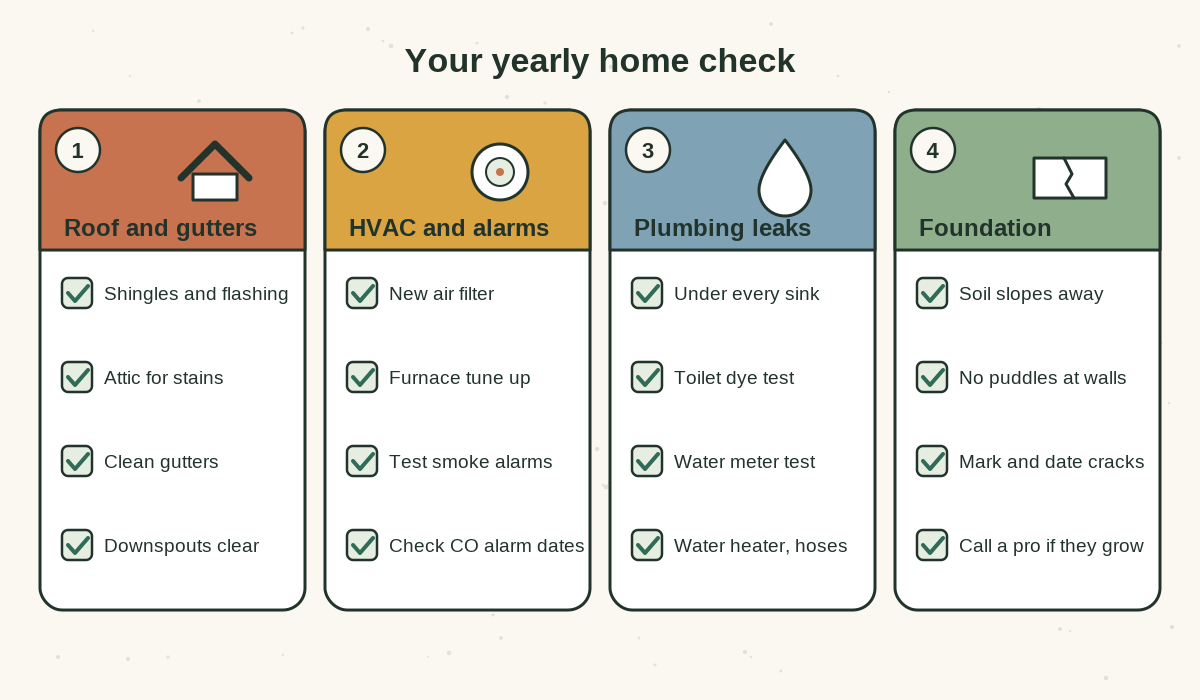
Task 1: Roof and gutters
Roof leaks usually show up inside long after the damage started. Walk around the house and look at the roof with binoculars. Look for missing, curled or cracked shingles, bare spots where the granules have worn off, sagging areas, and damaged flashing around the chimney, vents and skylights.
Then go inside and check the attic, if you can reach it safely. Water stains on the underside of the roof deck, damp insulation or daylight coming through are all warning signs. On a ceiling, a brownish ring is often the first clue of a slow leak.
Gutters need cleaning at least once or twice a year, more often under tall trees. Make sure downspouts are attached and send water several feet away from the house; many guides suggest at least 4 to 6 feet (1.2 to 1.8 m), using extensions or splash blocks.
Safety first
- Falls from ladders and roofs cause many serious injuries every year. If your roof is steep, high or wet, hire a roofer or gutter service instead.
- When you do use a ladder, set it on firm level ground, keep three points of contact, and have someone hold the base.
- Never work near overhead power lines.
Task 2: HVAC filter, smoke alarms and carbon monoxide alarms
Heating and cooling
A clogged air filter makes your furnace and air conditioner work harder. Most filters should be replaced every 1 to 3 months, more often with pets or allergies, so the yearly check is a good moment to buy a supply. Clear leaves and debris from the outdoor AC unit, and book a professional tune-up for fuel-burning furnaces and boilers each year, ideally before the heating season.
While you are at it, clean the dryer vent from the back of the dryer to the outside flap. Lint buildup is a well-known cause of house fires.
Smoke alarms
Press the test button on every alarm. The National Fire Protection Association recommends testing monthly, having alarms inside each bedroom, outside each sleeping area and on every level, and replacing smoke alarms 10 years after the date of manufacture printed on the back. Replace batteries yearly unless the unit has a sealed 10-year battery.
Carbon monoxide alarms
Any home with a gas furnace, gas appliances, a fireplace or an attached garage needs CO alarms outside sleeping areas and on each level. They wear out faster than smoke alarms; check the replacement date on the label, often 5 to 10 years depending on the model.
Task 3: Plumbing leaks
According to the EPA's WaterSense program, household leaks can waste nearly 10,000 gallons of water a year in an average home. Many of them are silent.
- Under every sink. Use a flashlight and feel the pipes, shutoff valves and the cabinet floor for moisture, stains or warped wood.
- Toilets. Put a few drops of food coloring in the tank and wait 15 minutes without flushing. Color in the bowl means the flapper leaks.
- Water meter test. Turn off all water use, note the meter reading, and check again after 1 to 2 hours. If it moved, you have a leak somewhere.
- Water heater. Look for rust, puddles or corrosion at the connections. Follow the manufacturer's advice on flushing sediment; hard water makes this more important (see our guide to hard water and softeners).
- Washing machine hoses. Look for bulges and cracks. Many manufacturers recommend replacing rubber hoses every few years; braided stainless hoses are a sturdier choice.
- Main shutoff. Find the main water shutoff valve, make sure it turns, and show everyone in the house where it is.
Task 4: Foundation and drainage
Water is the main enemy of foundations. Walk around the house after a rain if you can. Soil should slope away from the walls; a common building standard is a drop of about 6 inches over the first 10 feet (15 cm over 3 m). Look for puddles that sit against the house, mulch or soil piled above the siding, and downspouts that empty right next to the wall.
Then inspect the foundation from outside and, if you have one, from the basement or crawlspace. Thin vertical hairline cracks in poured concrete are common and usually come from shrinkage. Mark the ends with a pencil and the date so next year you can see whether they grew.
When to call a pro
Get a structural engineer or foundation specialist to look at horizontal cracks, stair-step cracks in block or brick walls, cracks wider than about 1/4 inch (6 mm), cracks that grow from year to year, or new problems with doors and windows that stick. These can point to soil movement or water pressure.
Gaps around pipes and along the foundation are also how mice and insects get in. Sealing them pays off twice; see keeping mice out for what to use.
Your yearly checklist
- Roof shingles, flashing and attic checked for damage or stains
- Gutters cleaned, downspouts draining away from the house
- HVAC filter replaced, furnace service booked, dryer vent cleaned
- All smoke and CO alarms tested, batteries and expiry dates checked
- Sinks, toilets, water heater and washer hoses checked for leaks
- Water meter test done, main shutoff located and working
- Soil slopes away from the foundation, cracks marked and dated
- Notes and photos saved for comparison next year
Frequently asked questions
When is the best time for a yearly home inspection?
Early fall works well for most climates: gutters can be cleaned after the leaves drop, and the furnace gets checked before you need it. In hurricane or wildfire areas, schedule it before that season instead.
Do I still need a professional home inspector?
Not every year. A professional inspection makes sense when buying or selling, after major storms, or when your own check turns up something you cannot judge.
What about radon?
The EPA recommends testing all homes for radon, a radioactive gas that cannot be seen or smelled. Do-it-yourself test kits are inexpensive, and retesting every couple of years or after renovations is a sensible habit.
Sources
- National Fire Protection Association: Smoke alarms, installing and maintaining
- US Consumer Product Safety Commission: Carbon monoxide safety
- US Environmental Protection Agency WaterSense: Fix a Leak Week, finding household leaks
- US Environmental Protection Agency: A Citizen's Guide to Radon
- US Department of Energy: Maintaining your air conditioner and furnace
- International Residential Code: Lot grading and drainage away from foundations
Comments
No comments yet. Tried this at home? Tell us how it went.