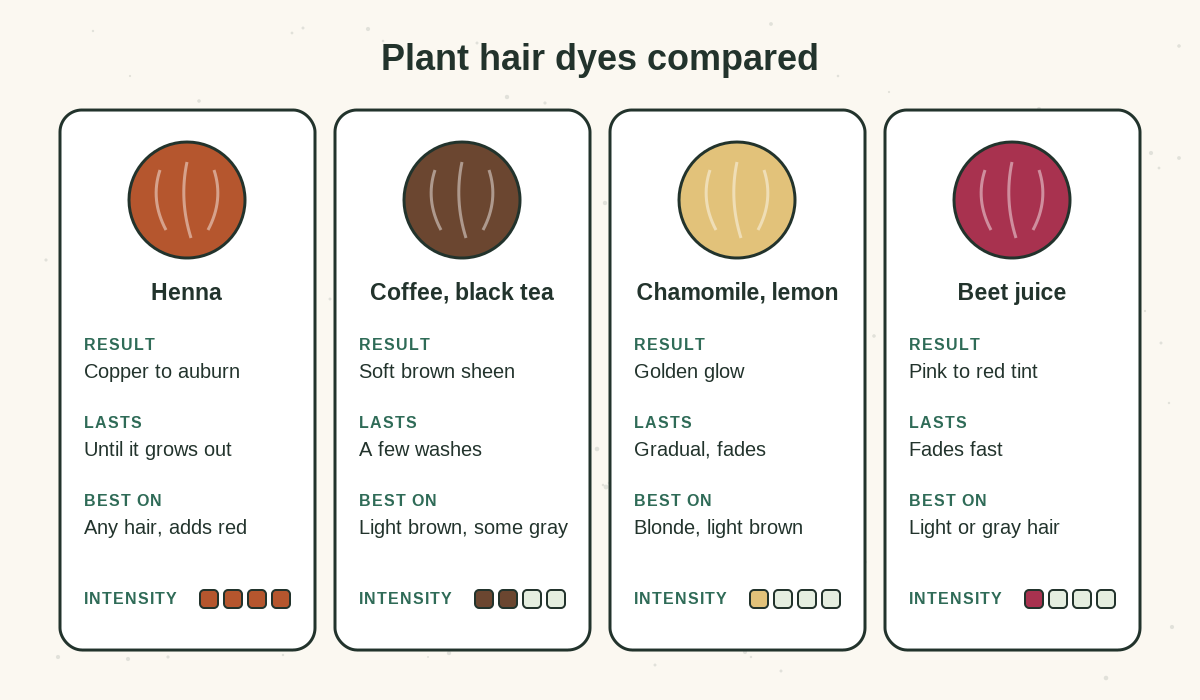
You can color hair at home with plant ingredients, but expect a tint, not a transformation. Pure henna gives a lasting copper to auburn color, coffee and black tea add a soft brown sheen to light hair, chamomile brightens blonde hair slightly, and beet juice leaves a reddish wash that fades in a few shampoos. None of them can lighten dark hair or cover a lot of gray with a natural looking brown or black.
The short version
- Henna is the only kitchen-style dye that is truly long-lasting. It always adds red, and it is hard to undo.
- Coffee, tea, chamomile and beet are rinses: subtle, temporary and best on light or gray hair.
- Do a skin patch test and a strand test before any dye, natural or not.
- Never use "black henna" on skin or hair. It often contains PPD, which can cause severe allergic reactions.
What homemade hair dye can and cannot do
Store-bought permanent dyes use chemistry to open the hair cuticle, remove some natural pigment and lock new color inside. Plant ingredients mostly stain the outside of the hair or bind to the protein on its surface. That has consequences.
- No lightening. Only bleach or peroxide-based dyes truly lift color. Lemon and chamomile can brighten already light hair a touch, nothing more.
- No exact shade. The result depends on your starting color, porosity and how long you leave it on. The same mix looks different on every head.
- Gray hair shows the most change. White hairs take on color easily, so a coffee rinse may look like highlights on gray hair and nearly invisible on dark brown.
- Repeat applications. Rinses fade with each wash and need to be repeated, often weekly.
Henna: the strongest natural option
Henna comes from the leaves of the plant Lawsonia inermis. Its dye molecule binds to the keratin in hair, so the color lasts until the hair grows out. The US Food and Drug Administration has approved henna as a color additive for hair only, not for direct use on skin.
Pure henna always gives orange, copper or auburn tones. Products sold as "brown henna" or "black henna" for hair are usually blends with indigo or other plants, and some contain added chemicals. Read the ingredient list: it should name only plants.
- Mix. Stir about 3.5 oz (100 g) of body art quality henna powder for shoulder length hair with warm water or brewed tea until it has the texture of thick yogurt. Some people add a splash of lemon juice. Cover and let it rest for a few hours so the dye releases.
- Prepare. Wash hair with plain shampoo, no conditioner. Rub a little oil along the hairline and ears and wear gloves; henna stains skin and nails for days.
- Apply. Work in sections from roots to ends, then wrap your hair in a shower cap.
- Wait. Leave it on for 2 to 4 hours. Longer usually means deeper color.
- Rinse. Rinse with water and conditioner until it runs clear. Skip shampoo for a day or two; the color keeps darkening for about 48 hours.
Henna and chemical dye do not mix well
If your hair has been bleached, permed or colored, test a hidden strand first. Compound hennas that contain metallic salts can react with later chemical dyes or perms and leave hair damaged or oddly colored. Pure henna is less of a problem, but many salons will still ask how long ago you used it, because covering or lifting henna is difficult.
Coffee and black tea: a soft brown sheen
Strong coffee or black tea can add warmth and depth to light brown hair and soften the contrast of a few grays. Brew a very strong pot, let it cool completely, and mix 1 cup (240 ml) with about 2 tablespoons of instant coffee and a cup of leave-in conditioner for a paste that clings. Apply to clean, damp hair, leave it on for an hour under a shower cap, then rinse with cool water. Repeat over several days for a visible change. Coffee will stain light towels and white grout, so lay down old ones. Leftover grounds are better used elsewhere; we list practical ideas in 10 great ideas for leftover coffee grounds.
Chamomile and lemon: brighter blonde, with care
A strong chamomile tea rinse can bring out golden tones in blonde or light brown hair. Steep 4 to 5 tea bags in 2 cups (about 480 ml) of hot water, let cool, pour over washed hair and let it dry. Repeat after each wash for a gradual effect.
Lemon juice in the sun is the classic summer trick. It can lighten light hair a little, but it also dries hair, and lemon juice on skin in strong sunlight can cause a burn-like rash with dark marks called phytophotodermatitis. If you try it, keep lemon off your face, neck and hands, rinse skin well and limit time in the sun. People who are sensitive to ragweed may react to chamomile.
Beet and carrot juice: a temporary red tint
Fresh beet juice gives a pink to red tinge on light hair and a faint warm glow on brown hair. Carrot juice adds a softer orange note. Mix the juice with a little coconut or olive oil, apply for an hour, then rinse with cool water and skip shampoo for a day. The color fades within a few washes, and it may rub off on pillowcases at first.
Safety first
- Black henna: the FDA warns that "black henna" often contains p-phenylenediamine (PPD), a coal tar dye. On skin it can cause blistering, scarring and lifelong allergy to PPD, which is also found in many permanent hair dyes. Avoid any henna that promises black color in under an hour.
- Patch test: dab a little of your mix behind the ear or inside the elbow and wait 48 hours before coloring, even with plant dyes. Plants cause allergies too.
- Eyes: never dye eyebrows or eyelashes with home mixes. Eye injuries from dyes are a known risk, and the FDA has not approved any color additive for dyeing brows or lashes.
- Get medical help if you notice swelling of the face, lips or eyes, trouble breathing, or blistering after a dye. That can be a severe allergic reaction.
Which option suits your hair?
- You want a lasting red, copper or auburn: pure henna.
- You want brown or black that lasts: henna followed by indigo in a second step is the natural route, but results vary. A salon or a store-bought dye is more predictable.
- You want to soften a few gray hairs on brown hair: coffee or black tea rinses.
- You are blonde and want more glow: chamomile rinses.
- You want a fun, short-lived tint: beet juice.
Rinses with tea or herbs can be combined with scalp care. If dandruff is part of the picture, our guide to tea tree oil for hair covers what it can do and how to dilute it.
Frequently asked questions
Can homemade hair dye cover gray hair?
Henna covers gray well but turns it bright copper. Coffee and tea give gray hairs a soft beige to light brown tint that fades. For a dark, even cover, natural rinses are not strong enough.
How long does a coffee or tea rinse last?
Usually a few washes. Using it regularly builds up color slightly, but it fades as soon as you stop.
Can I use henna if I already color my hair?
Test a strand first and wait until the chemical color has grown out a little. Avoid compound hennas with metallic salts, which can react with chemical dyes and perms.
Sources
- US Food and Drug Administration: Temporary Tattoos, Henna/Mehndi, and "Black Henna": Fact Sheet
- US Food and Drug Administration: Hair Dyes, safety and patch testing
- American Academy of Dermatology: Hair dye, tips to reduce damage and allergic reactions
- DermNet: Phytophotodermatitis
Comments
No comments yet. Tried this at home? Tell us how it went.