Japanese knotweed extract comes up again and again in online Lyme disease forums, usually as part of an herbal protocol. The honest answer is that its activity against the Lyme bacterium has only been shown in lab dishes, not in people. Antibiotics remain the only proven treatment for Lyme disease, and anyone with possible Lyme symptoms should see a doctor before trying any herb.
The short version
- Japanese knotweed (Polygonum cuspidatum) is an invasive plant whose root is a major commercial source of resveratrol.
- Laboratory studies found that knotweed extract can kill or slow Borrelia bacteria in a dish. No clinical trial has tested it in patients.
- Early Lyme disease is treated with a short course of antibiotics, which works well for most people when started promptly.
- Knotweed and resveratrol may slow blood clotting and interact with medicines. Talk to a doctor or pharmacist before taking it.
What Japanese knotweed is
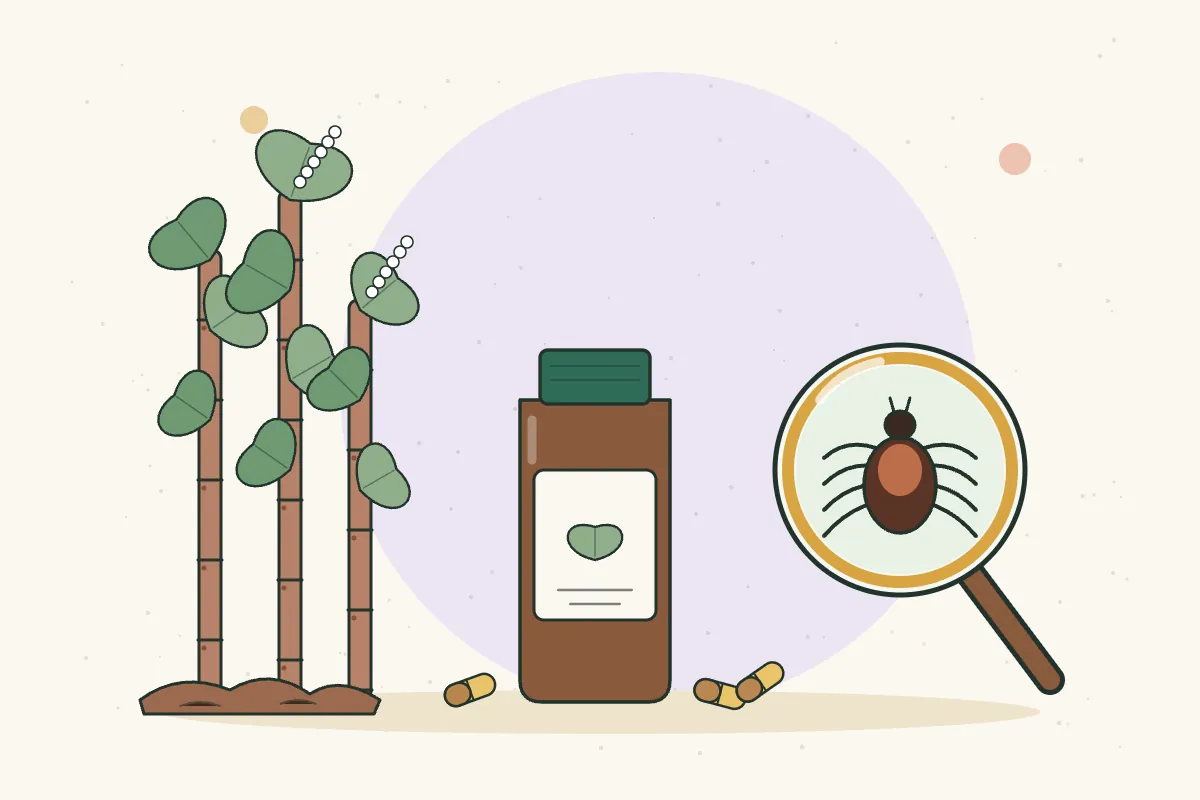
Japanese knotweed is a fast-growing perennial with hollow, bamboo-like stems and heart-shaped leaves. Botanists now usually call it Reynoutria japonica, though the older name Polygonum cuspidatum is still common on supplement labels. In much of the US it is listed as an invasive weed because it spreads through underground rhizomes and crowds out native plants.
The root has a long history in traditional Chinese and Japanese medicine, where it is known as Hu Zhang. Today it is best known as a raw material: much of the resveratrol sold in capsules is extracted from knotweed root rather than from grapes. The root also contains other compounds, including polydatin (a close relative of resveratrol) and emodin, an anthraquinone with a laxative effect.
Why it is linked to Lyme disease
Lyme disease is caused by Borrelia burgdorferi (and a few related species), bacteria spread by the bite of infected blacklegged ticks. Interest in knotweed comes from two directions.
The Buhner protocol
Herbalist Stephen Harrod Buhner popularized an herbal approach to Lyme disease in his book Healing Lyme. Knotweed is one of the core herbs in that protocol, alongside plants such as cat's claw and andrographis. The protocol is based on traditional use, lab findings about individual compounds and the author's own reasoning. It has never been tested in a controlled clinical trial, and it is not part of any medical guideline.
The laboratory studies
Research teams have screened dozens of plant extracts against Borrelia grown in the lab. In a widely cited 2020 study, Japanese knotweed was among a small group of extracts that showed strong activity against the bacteria, including slow-growing forms that tolerate some antibiotics in a dish. Resveratrol itself has also shown antibacterial effects in cell cultures.
That sounds promising, and it is a reasonable starting point for research. But a lab dish is very different from a human body. An extract that kills bacteria in a dish may not reach the right tissues, may be broken down quickly in the liver, or may need doses that are unsafe. Many substances that look powerful in the lab never work in people.
How to read the evidence
"In vitro" means "in glass": cells or bacteria in a lab dish. It is the earliest stage of research, followed by animal studies and then clinical trials in people. For knotweed and Lyme disease, research has not moved past that first stage.
What actually treats Lyme disease
For early Lyme disease, including the typical expanding red rash (erythema migrans), current US guidelines recommend oral antibiotics such as doxycycline, amoxicillin or cefuroxime, usually for 10 to 14 days depending on the drug. Most people recover fully when treatment starts early. Lyme disease that affects the heart, nerves or joints may need longer or intravenous treatment, which a doctor decides on.
Some people still have fatigue, pain or trouble concentrating months after treatment. This is called post-treatment Lyme disease syndrome. It is real and can be frustrating, but clinical trials found that long courses of extra antibiotics did not help more than placebo, and they carried real risks. It is a common reason people look into herbs. A doctor experienced with Lyme disease can help manage symptoms and rule out other causes.
Is knotweed safe to try?
Knotweed root and resveratrol supplements are widely sold and usually tolerated in short-term use at moderate doses. Still, they are not harmless, and quality varies, because supplements do not need approval for safety or effectiveness before they are sold.
Safety first
- Blood thinners: resveratrol may slow blood clotting. Combined with warfarin, apixaban, clopidogrel, aspirin or high-dose fish oil, it could raise bleeding risk. Stop it before surgery and tell your surgeon.
- Other medicines: resveratrol may affect liver enzymes that break down many drugs. Ask a pharmacist to check your medication list.
- Digestion: emodin in the root can cause loose stools and stomach cramps.
- Pregnancy, breastfeeding and children: there is no safety data. Do not use it.
- Hormone-sensitive conditions: resveratrol has weak estrogen-like activity in lab studies. Discuss it with your doctor if you have a history of breast, uterine or ovarian cancer, endometriosis or fibroids.
- Never as a replacement: using herbs instead of antibiotics for early Lyme disease can allow the infection to spread to the joints, heart or nervous system.
See a doctor if you notice these signs
Get medical care promptly if you have had a tick bite or spend time in tick areas and develop any of the following:
- An expanding red or bull's-eye rash, often larger than 2 inches (5 cm)
- Fever, chills, headache, body aches or swollen lymph nodes
- Drooping on one side of the face (facial palsy)
- Heart palpitations, dizziness, chest pain or shortness of breath
- Severe headache with a stiff neck
- Painful, swollen joints, especially the knees
- Numbness, tingling or shooting pains in the hands or feet
Prevention still matters most
The best way to deal with Lyme disease is to avoid it. Use an EPA-registered insect repellent such as DEET or picaridin on skin, treat clothing and gear with permethrin, walk in the center of trails and check your whole body, your children and your pets for ticks after time outdoors. Remove an attached tick with fine-tipped tweezers by pulling straight up with steady pressure, then clean the area. Showering within two hours of coming indoors also helps wash off ticks that have not attached yet.
Frequently asked questions
Can Japanese knotweed cure Lyme disease?
There is no evidence that it can. It has shown activity against Lyme bacteria only in lab dishes. Antibiotics prescribed by a doctor are the proven treatment.
Can I take knotweed alongside antibiotics?
Some people do, but there are no studies on the combination. Because of possible drug interactions and bleeding risk, ask your doctor or pharmacist first, and never stop or shorten an antibiotic course on your own.
Is resveratrol from knotweed the same as from red wine?
The molecule is the same. The amounts are very different: a glass of red wine contains only a tiny fraction of what a typical supplement capsule provides, which is also why supplements carry more risk of side effects and interactions.
Sources
- Centers for Disease Control and Prevention: Lyme disease, signs and symptoms, and treatment
- Infectious Diseases Society of America, American Academy of Neurology and American College of Rheumatology: 2020 clinical practice guidelines for the prevention, diagnosis and treatment of Lyme disease
- Frontiers in Medicine: 2020 laboratory study evaluating botanical extracts for activity against growing and non-growing Borrelia burgdorferi
- NIH National Center for Complementary and Integrative Health: Lyme disease and complementary health approaches
- Memorial Sloan Kettering Cancer Center, About Herbs: Resveratrol and Polygonum cuspidatum
Comments
No comments yet. Tried this at home? Tell us how it went.